About the talk
Heidi Becker of NASA’s Juno mission takes the audience at the Iziko Planetarium to Jupiter “through the eyes of Juno”, in a talk convened by SAPIENT. A half-hour tour is followed by a long question and answer session.
What the talk covers
- Jupiter and the Juno spacecraft. Jupiter is so big that a thousand Earths would fit inside it, and understanding it is a first step to understanding how the solar system formed. Juno is a solar-powered, spinning robot about the size of a basketball court, cartwheeling twice a minute, with instruments to look at the cloud tops, deep inside the planet, at its chemistry and at its powerful magnetic field. At Jupiter the sun is 25 times dimmer than on Earth, which is why the solar panels are so large.
- The scariest place to fly a spacecraft. Jupiter spins once every 10 hours, and its huge magnetic field traps electrons and accelerates them to almost the speed of light.
- Blowing a kiss to Cape Town. The rocket could only carry Juno as far as the asteroid belt, so Juno returned to Earth two years after launch and used its gravity as a slingshot. Its closest approach, about 350 miles away, was over Cape Town on 9 October 2013, and someone near Cape Town photographed Juno as a bright streak in the sky.
- Sailing by the stars. Juno steers using a star camera. Jupiter’s radiation puts dots and squiggles in its pictures that look like starlight, “like trying to sail through a snowstorm”, so the camera looks only for the 300 brightest stars and knows that radiation has a different shape from a star. Heidi’s job was to count the squiggles to measure how high the radiation was. The same camera saw the constellation Orion looking just as it does from Earth, even from 600 million kilometres away. It also caught tiny flashes of lightning on Jupiter’s cloud tops, powered by ammonia raindrops colliding with ice crystals, and is now an official science instrument on Juno.
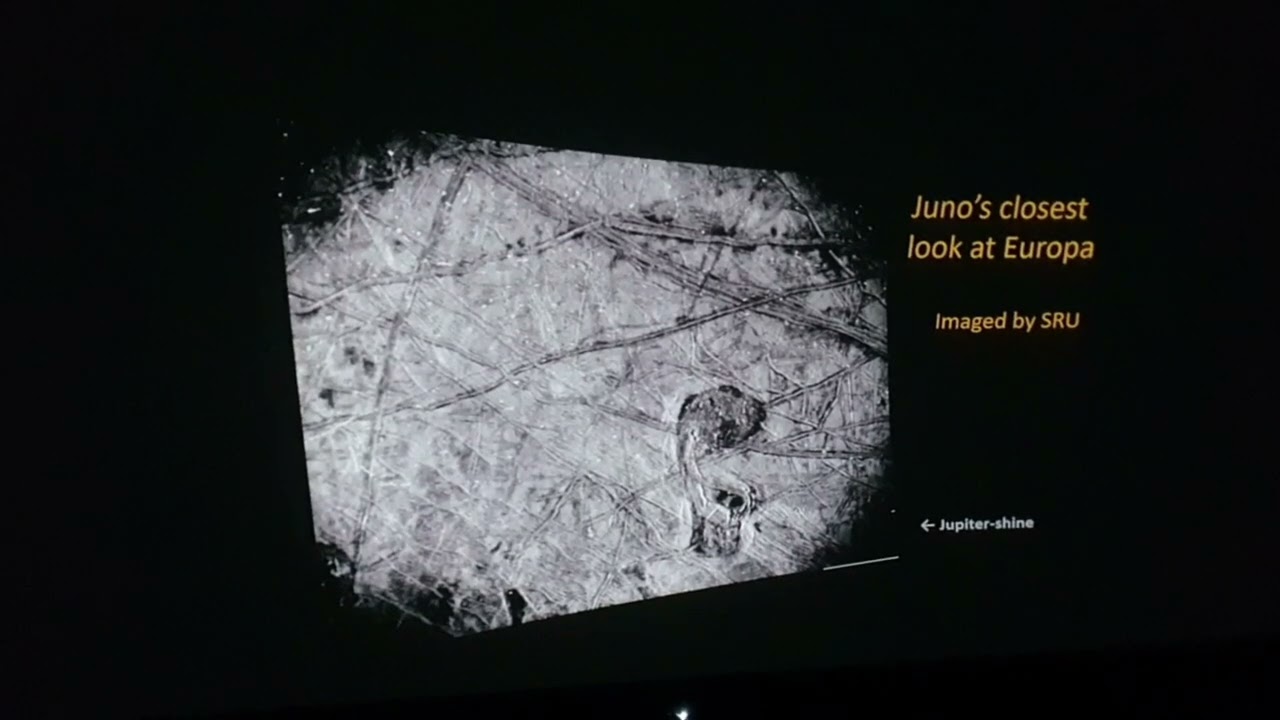
- Europa and a platypus. Jupiter’s moons Io, Europa and Ganymede move in resonance, something Galileo worked out with just a telescope. Europa’s icy shell has twice the water of all Earth’s oceans beneath it. A feature in a Juno image of the shell looks like a platypus to the team. It may be a collapsed patch of ice with liquid water underneath, and the Europa Clipper and JUICE missions have been asked to look at it.
- Jupiter as art. Citizen scientists process JunoCam images, from realistic views to modern art, including a Great Red Spot that looks like a mermaid.
- Questions. Could humans go there? Not now: in a metal box you would get something like 100 million dental x-rays at once. Jupiter seems to have a fuzzy core rather than a solid one, which no one can yet explain. Juno measures how Jupiter’s gravity tugs on its radio signal to work out the interior. There are five polar storms in the south and eight in the north. Sticky valves in the fuel system meant Juno stayed in its 53-day orbit and took longer to finish its science. Three small aluminium Lego figures of Galileo, Jupiter and Juno ride aboard. Heidi came to science from dance, starting with a night class in calculus at about 26. The spacecraft is named for the goddess Juno, who could see through the veil Jupiter hid behind. And nobody knows whether radiation or the fuel will end the mission first.
Juno is a robot that scientists command from a very long way away, and a small engineering camera that became a science instrument. It is a good picture of what SAPIENT wants for learners: planetary science and technology working together, and many paths into science, as Heidi’s own from dance shows. The Mars Yard gives learners a small version of that experience, where they write code, send it to mission control, and watch a rover carry it out on Mars-like terrain.