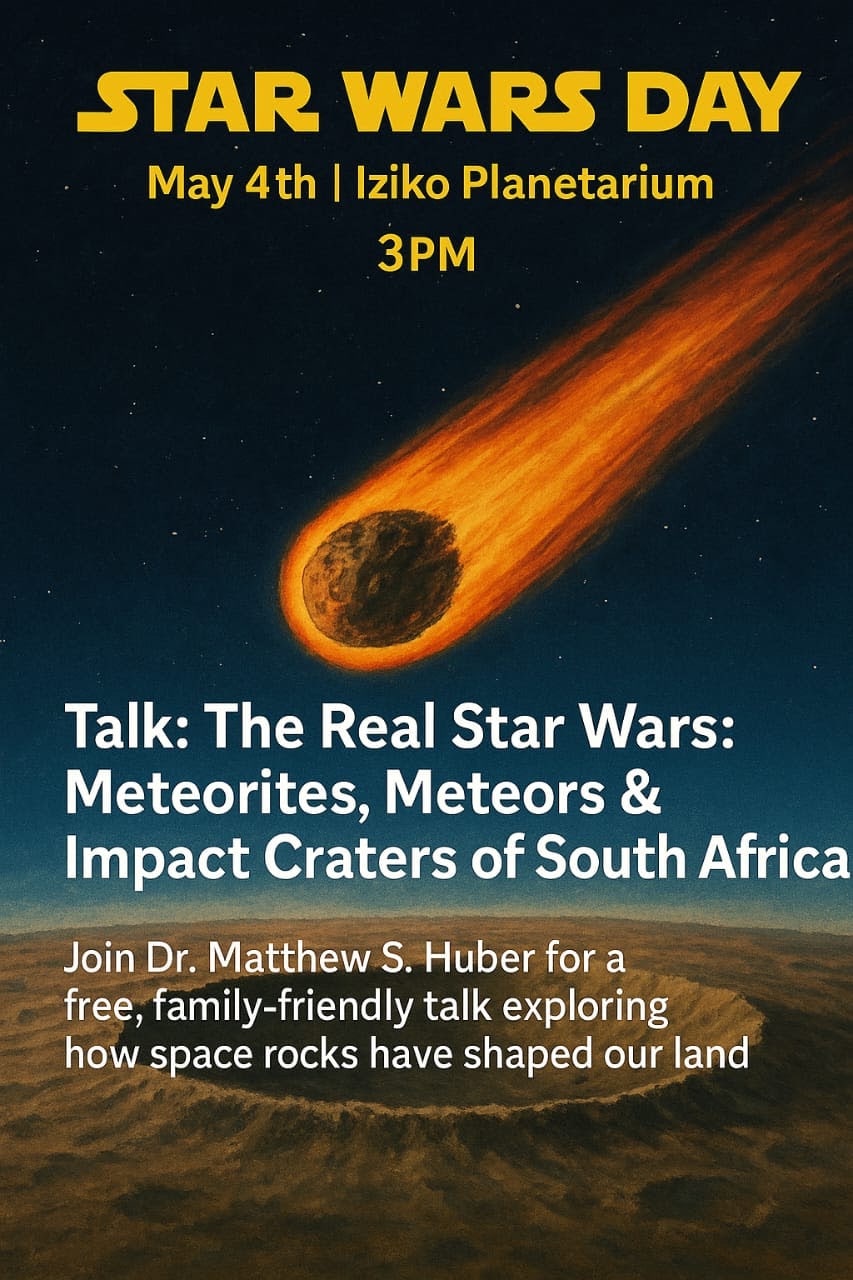
About the talk
Dr. Matthew S. Huber’s free public talk for Star Wars Day (4 May 2025) at the Iziko Planetarium in Cape Town, for curious young minds.
What the talk covers
- A tour of the solar system, with the audience answering. One star, eight planets, five dwarf planets, 423 moons, 4,014 known comets and 1,446,950 identified asteroids. The Earth passes through a “shooting gallery” of rocks, and about 40,000 tonnes of material falls to Earth every year.
- Meteorites from Vesta. NASA’s Dawn mission visited the asteroid Vesta, whose giant Rheasilvia crater threw out the howardite, eucrite and diogenite meteorites. One howardite fell in the Eastern Cape on 25 August 2024, caught on camera, with a rock dropping out of a tree.
- South Africa’s meteorite story. The Cape of Good Hope meteorite, found in 1793 and later forged into a sword for Tsar Alexander I, and the Hoba meteorite in Namibia, too heavy to move.
- When they get big. The 2013 Chelyabinsk airburst damaged around 3,000 buildings, and most injuries came from window glass. The Tswaing crater near Pretoria, about a kilometre wide and over 200,000 years old, shows a classic bowl-shaped crater.
- Vredefort. An impactor on the scale of Table Mountain, doubled a few times, made the largest impact structure in the world, about 2 billion years ago. A simulation shows rock plunging 40 km down and rebounding 20 km up in under three minutes. Shatter cones, melt dikes and pseudotachylite are the evidence, and the uplifted gold-bearing layers gave the world about a third of all the gold ever found.
- What’s next. South Africa has four confirmed impact craters, with more waiting to be found. SAPIENT aims to share planetary science alongside programming and robotics.
The talk is the planetary-science half of SAPIENT’s story, told for curious young minds, from meteorites in the sky to craters in the ground. The other half is technology. The Mars Yard puts a real rover on Mars-like terrain, and learners drive it with code, so a child who has just heard about rocks from space can go on to explore a landscape like Mars themselves.